Context of Visualization
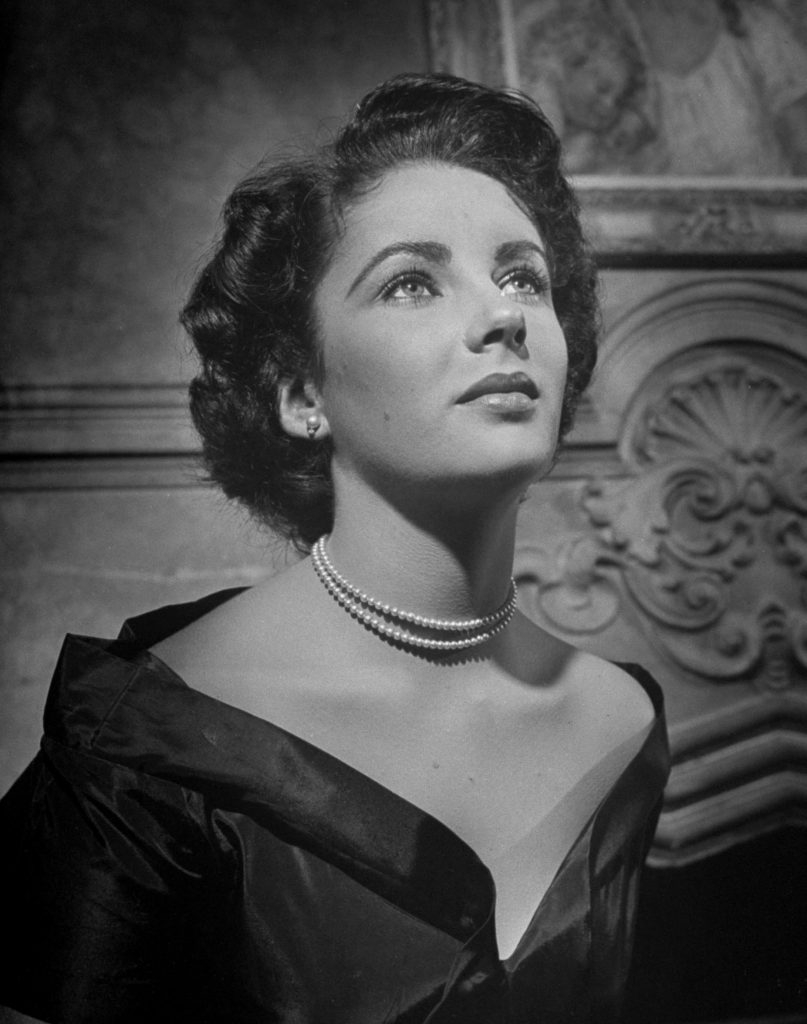
Elizabeth Taylor began acting when she was a child and quickly became a Hollywood Starlet before becoming a legal adult. Born on February 27th, 1932, Taylor was less than a year younger than Debbie Reynolds meaning she was raised in the same societal expectations. In regards to the cultural zeitgeist, she was anything but – instead “[s]he was a prima donna whose shopping sprees and sex scandals invited readers to fantasize on the baroque scale” (Higashi, 117). Photoplay’s titles of Liz asked if she was a “Spoiled Brat or Mixed-Up Teenager?” By 1948, Taylor was a polarizing figure. This lens that Taylor was scrutinized under – that of smutty scandals and offensive nature – was not one that parents would want their children to be associated with. Our group questioned if the popularity of the name Elizabeth would drop as Taylor rose to fame as a prominent sex symbol.
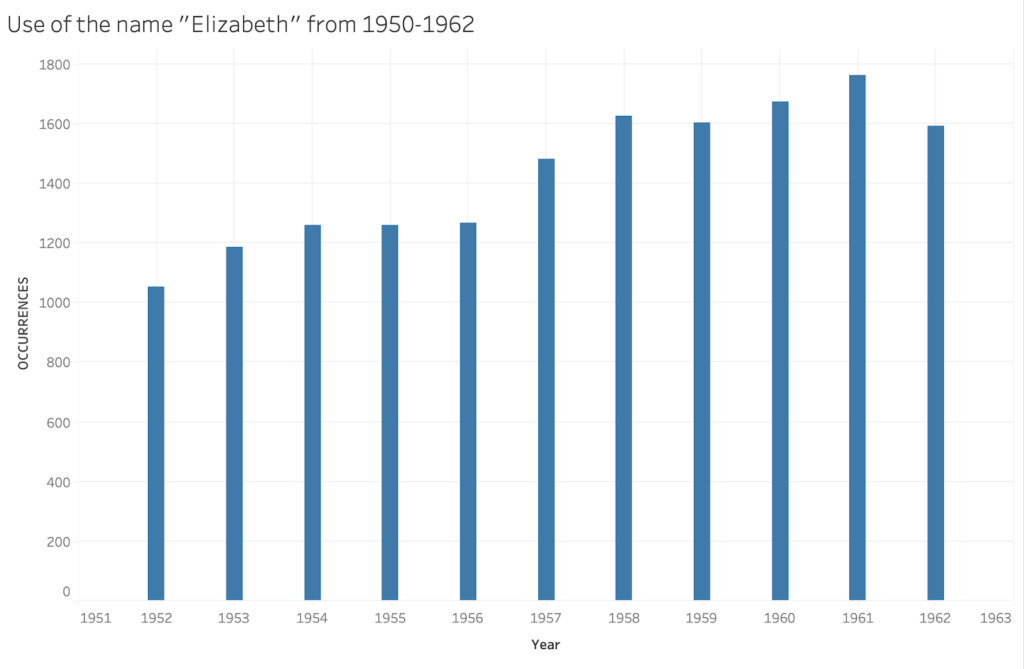
The cut off point for our data was one thousand occurrences; any number below that was removed in our data cleaning process. The lack of a bar in the year 1951 on our visualization means that the name had less than 1,000 occurrences at the turn of the century. This could be due to Taylor’s notoriously temperamental nature in 1949 – the year she called off her engagement to instead marry hotel heir Conrad (Nicky) Hilton. Every romantic conquest Taylor pursued was rigorously covered and scrutinized, taking up a two-column spread in The New York Herald Tribune and a full page in Life, both in 1949 (Maddox, 66). Her fame was rising, however she was a quick feature here and there – nowhere near the stardom she would grow into.
The Data & Its Implications
She starred in Father of the Bride (1950) and “[w]ith respect to age, she was typical of the teenagers who comprised 50 percent of the brides reciting vows in that decade as marriage rates soared” (Higashi, 118). At every instance, MGM pushed the image that Taylor was an albeit glamorous but nonetheless attainable girl. Yet Taylor, always subverting expectations, was never described as the picture-perfect housewife the media and her managers wanted her to be. Hilton, her first husband, called her “unrealistic and romantic” with “very little housewife in her”, her second husband, Michael Wilding would go on to add. With her second husband twenty years her senior, Taylor gave birth to Michael Howard Wilding Jr. in 1955. Two years later, the two would separate, making this Taylor’s second divorce by age twenty-five. This could have discouraged parents from naming their child Elizabeth, scared that the negative connotation would be associated with their baby.
At this point in her career along in the beginning of the fifties, Taylor was seen and treated like “a valuable idiot” (Maddox, 95). “The fifties were a conformist time for women” (Maddox, 102) where it was unthinkable for a woman to tend to her career if she did not already have a husband and children waiting at home – Taylor fit herself into this expectation as best she could and was revered for it, even being called Mother of the Year in 1953 by America’s florists (Maddox, 105).
The 1956 film Giant thrust Taylor back into society’s good graces with its raving reviews that allowed her to be taken seriously again as an actress. However, she was emerging as a sex symbol, always sultry, always pandering to the pleasure of the men around her. Still, the name’s popularity rose the next year from 1,268 to 1,479 occurrences in 1957. This exactly coincides with the creation of the Elizabeth Taylor mantle that came to fruition during her marriage to Mike Todd. During those years, she grew to a level of fame and interest to audiences that her every move was voyeured; fans and paparazzi alike crowded the studio and fought just to get a look at her.
“The transformation wrought by Todd was total. He woke Taylor up sexually, professionally, and financially” (Maddox, 120).
Todd would die in a tragic airplane crash on March 22nd, 1958; the ordeal was worsened when Todd’s best friend, Eddie Fisher, grew closer to Taylor in their tandem grief. At the time, he was married to Debbie Reynolds – the pair would separate in February of 1959 so that Taylor and Fisher could tie the knot on May 12th, 1959. The occurrences would jump up to 1,623 in 1958. With this context, the hypothesis was proven wrong: even in a shroud of controversy, the popularity of the name Elizabeth steadily and surely grew alongside Taylor’s notoriety.
However the main point stands uncontested: Elizabeth Taylor’s award-winning years produced significantly more occurrences. She was nominated for her first Academy Award for Best Actress in 1958 for Raintree Country, the occurrences increasing by 13% from the year before. She received the same nomination the next year for Cat on a Hot Tin Roof, however she was amidst her divorce with Eddie Fisher, a long and messy procession, and the occurrences dropped slightly. For a third year in a row, Taylor received the same nomination for Suddenly, Last Summer. Our thesis reaches the zenith of evidence along with the occurrences of the name Elizabeth: 1961, the year that Elizabeth Taylor finally won the Oscar for Best Actress for Butterfield 8, there were a record number of 1,761 occurrences.